

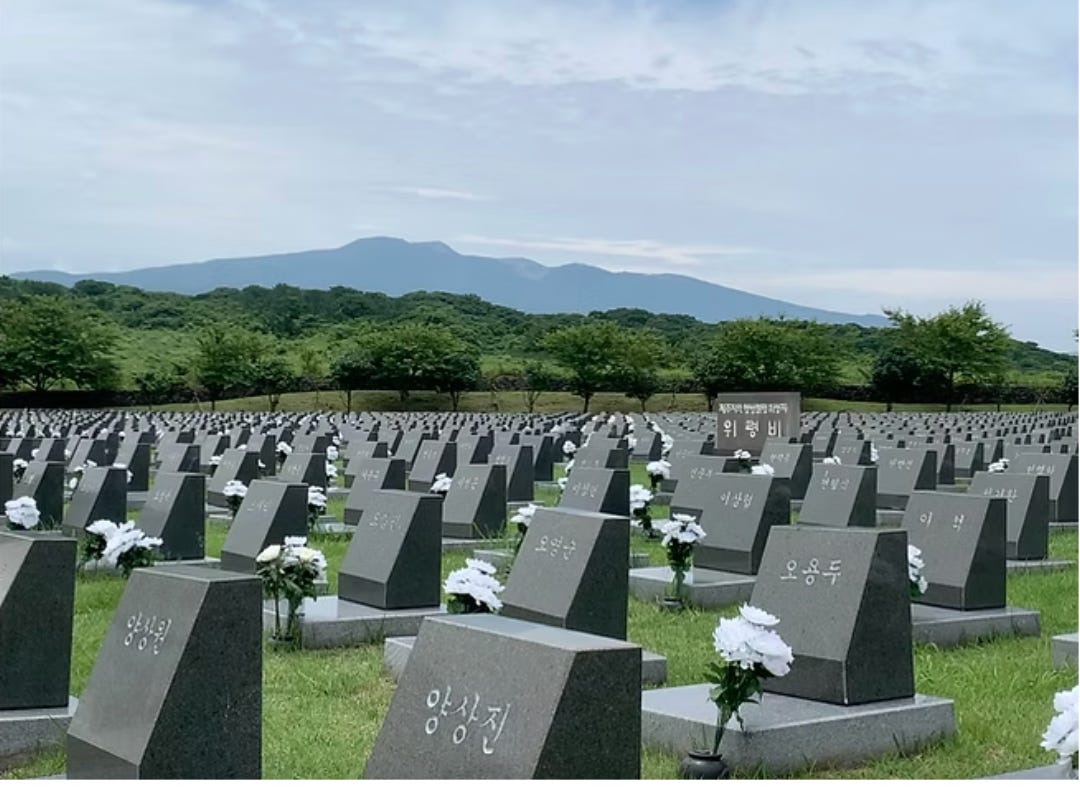
Professor Sung-Yoon Lee’s 2022 op-ed in The Hill argues that remembrance, truth-seeking, and reconciliation should begin with a presidential visit to the Jeju April 3 Peace Park.
In an op-ed published in The Hill on April 6, 2022, Sung-Yoon Lee, a professor at The Fletcher School of Law and Diplomacy at Tufts University, makes a clear and consequential argument: a U.S. presidential visit to the Jeju April 3 Peace Park would be a meaningful starting point for the United States in addressing the unresolved grievances of the victims of the Jeju 4·3 Incident. Southwestern Law School
Jeju Island witnessed the systematic killing of civilians beginning in 1948, a tragedy made more complex by the historical context of U.S. authority on the peninsula during the period of the U.S. Army Military Government in Korea (USAMGIK). Lee emphasizes the moral and diplomatic importance of remembrance and reconciliation, pointing to the significance of public gestures that acknowledge victims and validate historical pain. House Docs+1
The op-ed argues that both South Korea and the United States have, at different times, minimized or avoided full accountability, slowing the pursuit of truth and reconciliation. The mass killing of civilians, including women and children, and the destruction of communities, remains a critical but insufficiently understood chapter in post-1945 Korean history that warrants sustained attention in the United States. House Docs
Lee specifically suggests that when President Joe Biden travels to South Korea, he should pay respects at the Jeju 4·3 Peace Park as an act of acknowledgment and a gesture toward healing that could strengthen the U.S.–ROK relationship. He also proposes that Congress can contribute to reconciliation through tangible support, including educational initiatives for victims’ families, drawing on precedents in which the United States has addressed past wrongs through public recognition and material measures. House Docs+1
At its core, the piece calls for the Jeju 4·3 Massacre to be recognized as a shared historical and ethical issue, not solely a domestic Korean tragedy. It urges actions that support truth-telling, public memory, and reconciliation as foundations for a more mature and credible bilateral partnership. House Docs
To read the full op-ed, please visit:
https://thehill.com/opinion/international/3258230-biden-should-visit-south-koreas-jeju-april-3rd-peace-park/