

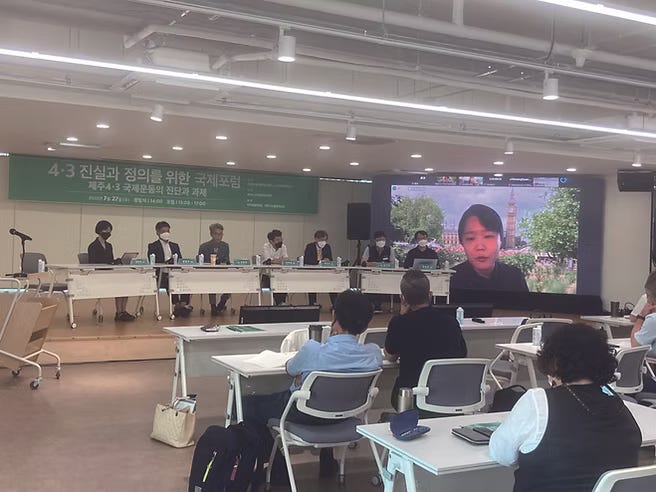
The Jeju 4·3 International Network for Truth and Justice was established at 2:00 p.m. KST on June 27, 2022, at the Jeju City Communication and Cooperation Center. Participants from Jeju, Seoul, Japan, the United States, Europe, and Taiwan joined forces to advance truth and justice related to Jeju 4·3.
Seven organizations formed the initial coalition, with the Jeju Association for the Bereaved Families of 4·3 Victims serving as the central hub. The founding members included the Jeju 4·3 Pan-National Committee to Commemorate the Jeju 4·3 Massacre, the Memorial Committee for the Jeju 4·3 Uprising and Massacre, the Association for the Bereaved Families of 4·3 Victims in Japan, the Jeju 4·3 Victims and Families Association in the U.S., the Taiwan Jeju 4·3 Victims Association, and Jeju 4·3 Network Europe. Two additional groups, Jeju 4·3 Network Tokyo and Jeju 4·3 Network Osaka, were also reported to be in preparation.
At the founding ceremony, representatives of each organization participated by video conference. Jeju Provincial Governor Oh Young-hoon and National Assemblyman Kim Han-kyu (Democratic Party) delivered congratulatory remarks, and Koh Hee-beom, Chair of the Jeju 4·3 Peace Foundation, attended in person and offered congratulatory comments.
In its founding declaration, the Network stated that it aims to serve as a catalyst for connecting the next generation by fostering the spirit of Jeju 4·3 and resistance to injustice, reaffirming commitments to peace and human rights.
A spokesperson emphasized that the Jeju 4·3 Massacre, which claimed an estimated 10 percent of Jeju’s population at the time, occurred 74 years ago but should not be treated as a problem unique to Jeju. The statement located Jeju 4·3 within the post–World War II geopolitical struggle on the Korean Peninsula, describing it as a history in which Jeju residents sought to shape their future after liberation rather than have it dictated by great powers.
The spokesperson also highlighted that progress on truth and justice was achieved through sustained efforts by bereaved families, civic society, and Jeju 4·3 organizations, leading to the enactment of the Jeju 4·3 Special Act, the adoption of a government-level fact-finding report, and a presidential apology. Subsequent amendments to the Special Act were described as historic steps enabling compensation and retrials through state mechanisms.
The statement further noted that in the 1970s and 1980s, when open discussion of Jeju 4·3 was extremely difficult in Korea, early calls for truth-seeking first emerged in Japan. It pointed to more recent developments, including the formation of the Jeju 4·3 Victims and Families Association in the United States and the establishment of Jeju 4·3 network initiatives in Taiwan. It also referenced ongoing activities in other countries, including the United Kingdom and the Netherlands, aimed at advancing international awareness and fact-finding.
Looking ahead, the Network stated its intention to pursue truth and accountability regarding the role of the U.S. Army Military Government in Korea (USAMGIK). It framed historical truth as something that does not arrive automatically but must be built through collective action across generations, emphasizing solidarity as the foundation for a more just future.
Representatives participating in the founding ceremony stated that the Network will collaborate across civil society networks, strengthen international awareness, and investigate the role of USAMGIK in Jeju 4·3. Organizers noted that the Memorial Committee for the Jeju 4·3 Uprising and Massacre began reaching out to Jeju 4·3-related associations worldwide in September 2020. Formal discussions on establishing the international network began in January 2021, and the Network was launched six months later. Each participating organization appointed a co-representative, and a joint secretariat was formed, composed of co-representatives and directors responsible for key areas of work.
The Jeju 4·3 International Network for Truth and Justice plans to organize international forums and seminars, develop solidarity projects, expand international representation of Jeju 4·3 history, and strengthen cross-border cooperation to advance peace and justice.