

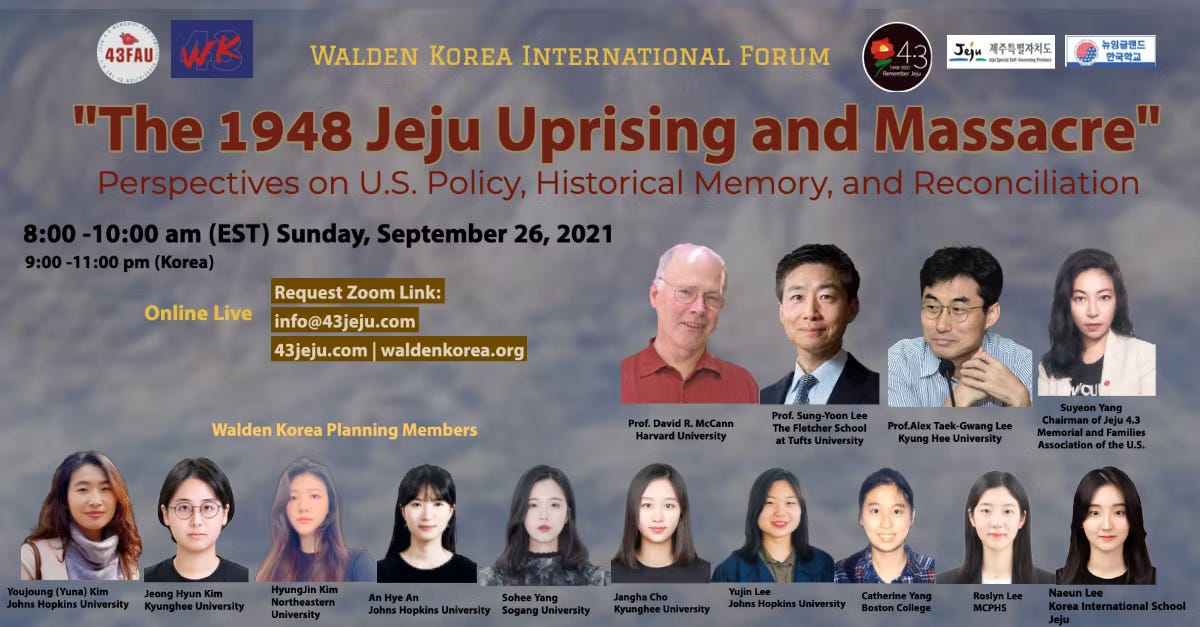
On September 26, 2021, the international forum titled [International Forum] The 1948 Jeju Uprising and Massacre: Perspectives on U.S. Policy, Historical Memory, and Reconciliation was held. Organized as a joint project by the Walden Korea Planning Committee, the forum examined Jeju 4·3 through three interrelated lenses: U.S. policy, historical memory, and the conditions of reconciliation.
The principal presentations were delivered by Professor David McCann of Harvard University, Professor Taek-Kwang Lee of Kyung Hee University, Professor Sung-Yoon Lee of The Fletcher School at Tufts University, and Chairwoman Suyeon Yang of the Jeju 4·3 Memorial and Families Association of the U.S. The forum’s guiding frame, “Re-Placing Memory: Jeju 1948–49 and Thereafter,” approached Jeju 4·3 not as a closed chapter but as an ongoing ethical and educational question that requires renewed language, renewed inquiry, and renewed public responsibility.
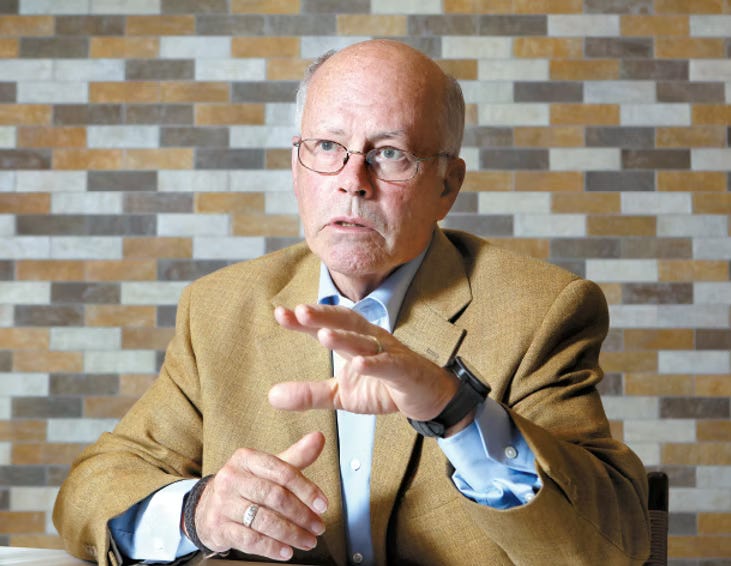
Professor David McCann explored Jeju 4·3 through Korean resistance literature and the poetry of remembrance. He read Kim Yeong-sook’s poem, “Jeongbang Waterfalls in Jeju Island,” in the original Korean and discussed Jeongbang Falls as one of the major sites where Jeju residents were killed. He then examined additional poems that confront the tragedy, including “Every Memorial Stone” by Lee Jong-hyeong and Ko Un’s “Jeju Island Poet.” McCann emphasized that poetry functions not merely as representation but as an apparatus of mourning and testimony, a medium through which collective memory is preserved and transmitted. His presentation underscored how literary language can articulate human rights and ethical attention where historical violence is often reduced to silence or abstraction.
Professor Sung-Yoon Lee interpreted Jeju 4·3 in relation to the political character of state power and the mechanisms by which violence is legitimized. He argued that primary responsibility lies with the Syngman Rhee government and raised questions about how political mythology and authority contributed to escalation and concealment. He further maintained that the historical conditions of the U.S. Military Government on the peninsula must be taken seriously, and that U.S. presence and advisory structures shaped the environment in which decisions were made. In this view, U.S. responsibility cannot be treated as peripheral to the broader context of the events. His remarks positioned Jeju 4·3 within the post-liberation order and the international political conditions that framed the early Cold War era.
Chairwoman Suyeon Yang centered her remarks on the enduring pain carried by victims’ families and the intergenerational marks left by the massacre. She emphasized that migration does not dissolve remembrance, and that the question becomes how to preserve, translate, and transmit memory across languages and locations. Yang also stressed the necessity of meaningful U.S. reflection and public accountability in light of the historical entanglement of Jeju 4·3 with the U.S. Military Government period. Her remarks clarified that reconciliation is not a sentimental closure, but a process that requires truth-telling, responsibility, and sustained public education.
Professor Taek-Kwang Lee situated Jeju 4·3 within a global historical frame. He proposed Jeju 4·3 as an early and consequential point of entry for understanding how the Cold War formed and expanded, and argued that the event’s international implications are often lost when it is confined to a narrowly local or domestic narrative. He suggested pathways for expanding Jeju 4·3 discourse into international conversations on human rights, state violence, memory politics, and transitional justice. He emphasized that as Jeju 4·3 is translated into a broader ethical and scholarly language, opportunities widen for research collaboration, education, and transnational solidarity.
Taken together, the forum advanced a shared task: to confirm historical truth while also asking how testimony and memory can become durable forms of public language, and what structures of responsibility are required for reconciliation. By bringing literary witness, political analysis, family testimony, and global historical framing into the same space, the forum presented Jeju 4·3 as a complex event that cannot be stabilized by a single explanatory lens.
Walden Korea plans to build on this foundation by convening an annual international forum on Jeju 4·3 and by sustaining related research, lectures, and public education programs.