

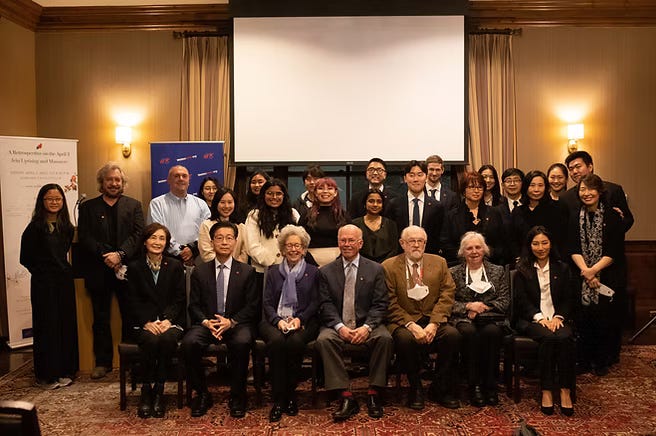
The journey of a thousand miles begins with a single step. This spring, that step was taken. For the first time on American soil, to the best of my knowledge, events were organized specifically to raise public awareness of a dark chapter of modern history: the Jeju 4·3 Uprising and Massacre, often referred to as the Jeju Island Massacres.
On April 1, the Jeju April 3 Victims Memorial Ceremony was held at the Harvard Faculty Club. Harvard University, a place where scholarship has shaped public understanding for centuries, provided a fitting setting for words that sought to bring light to a tragedy long obscured by distance and silence. The program featured local speakers whose expertise and tone combined intellectual rigor with humility and empathy: Professor David McCann (Harvard University), Professor Edward Baker (Harvard University), Professor Sung-Yoon Lee (The Fletcher School at Tufts University), and Ms. Suyeon Yang, Chairwoman of the Jeju 4·3 Memorial and Families Association of the U.S.

Together, the speakers offered a troubling yet necessary portrait. Professor Baker opened by situating the massacre within its historical context and arguing that the United States bears responsibility in this chapter of Korean history. A history not distant in time, yet too easily forgotten. Professor McCann then approached the tragedy through literature, illustrating how the pain of Jeju’s victims has been preserved and transmitted through poetry and testimony. These perspectives did not merely describe suffering; they raised the moral and political questions that follow any account of mass violence: how such atrocities become possible, who authorizes them, and how ideology and power can transform ordinary systems into instruments of terror. In combination, the presentations deepened understanding of what happened and why the painful past continues to shape the present.

The Harvard event blended commemoration with short lectures and was hosted by Walden Korea, an academic and cultural platform, and the Jeju 4·3 Memorial and Families Association of the U.S. It brought together graduate students from Tufts and Harvard, along with researchers and community members interested in Korean history, and it highlighted how much remains unknown in the American public sphere about the complex history of Jeju 4·3. The event’s significance was not only in the facts shared but also in the deliberate decision to speak openly—placing the subject in public view rather than leaving it under the cover of silence.

New York Commemoration Continues the Momentum
Eight days later, on April 9, a second commemoration was held at the New York Academy in Bayside, New York, continuing the effort to raise awareness on American soil. The service opened with a screening of Jiseul: Unfinished Years 2, directed by Oh Mook, which depicts the story of Jeju 4·3. Ms. Yang followed with remarks that held together historical facts and emotional truth, emphasizing that this history is not abstract but lived, inherited, and enduring.
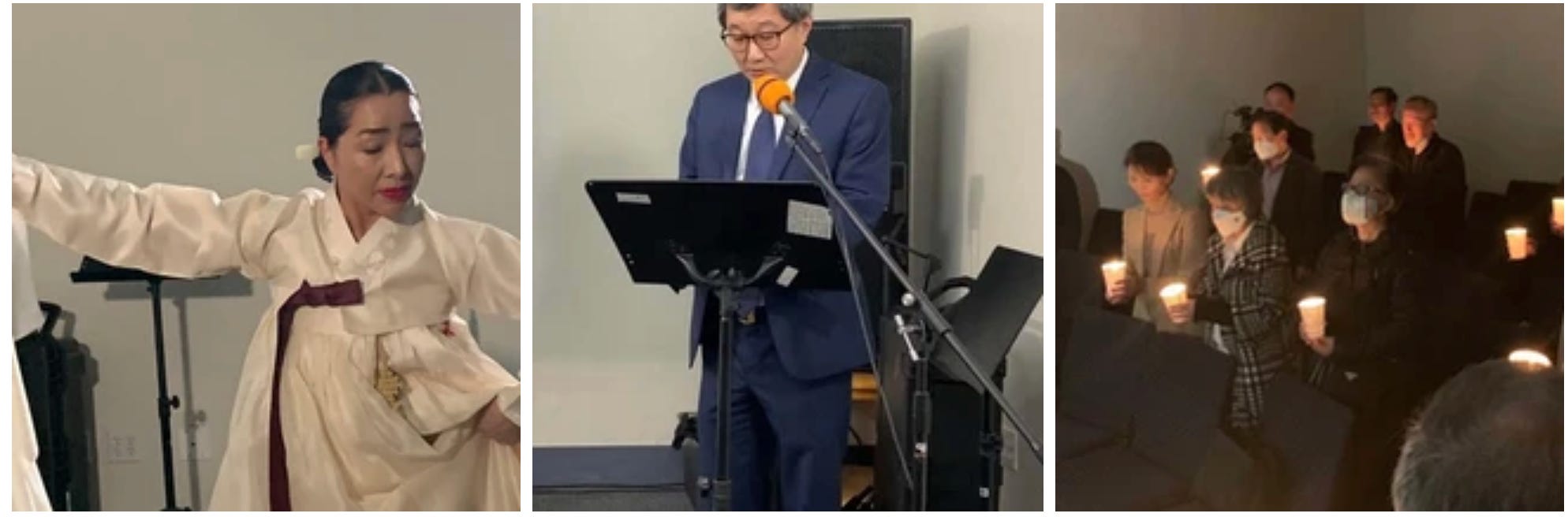
A memorial poem, “Before the Law,” by poet Heo Young-sun, was recited by Jennifer Eun Joo Kim. The commemoration concluded with a salpuri dance performed by Kang Eun-ju, an expressive and fitting finale for an event dedicated to mourning and remembrance. Sungyoon Park presided as master of ceremonies. Due to COVID-19, attendance in person was limited to pre-registered participants, while many others joined via Zoom.
Although these events represent only early steps, they are meaningful steps toward truth-telling and reconciliation. There is no truth without awareness, no awareness without sustained effort, and no justice without truth. Walden Korea and the Jeju 4·3 Memorial and Families Association of the U.S. plan to continue public education and commemoration efforts to ensure that the victims of Jeju 4·3 do not remain invisible.
During the Harvard program, Professor Sung-Yoon Lee, a prominent scholar of Korea and U.S.–Korea relations, issued a direct call for President Joe Biden to pay respects at the Jeju 4·3 Peace Park—an 88-acre memorial sanctuary on Jeju Island dedicated to the victims. He noted that President Barack Obama visited the Hiroshima Peace Memorial Park in 2016 and argued that Jeju 4·3 deserves comparable recognition.
Ms. Yang then spoke from an explicitly personal position. For her, Jeju 4·3 is not simply a historical subject; it is family history. She shared that her father lost his father and two brothers—her grandfather and uncles—in the massacre, and she underscored how discussion of Jeju 4·3 was suppressed for decades by the state, leaving many families to carry their grief in silence.
The Harvard event also included recorded video remarks from South Korea, expanding the forum beyond U.S.-based speakers. Those featured included philosopher Doh-ol Kim Yong-ok; Oh Im-jong, Chair of the Jeju 4·3 Bereaved Families Association; Oh Kwang-hyeon, Chair of the Jeju 4·3 Bereaved Families Association of Japan; Koh Hee-beom, Chair of the Jeju 4·3 Peace Foundation; Heo Young-sun, Director of the Jeju 4·3 Research Institute; Oh Young-hoon, Member of the National Assembly; and Professor Taek-Kwang Lee of Kyung Hee University.
These two commemorations—one at Harvard and one in New York—mark the beginning of a broader American-facing effort: to confront the historical record, expand public knowledge, and move toward accountability and reconciliation grounded in truth.